
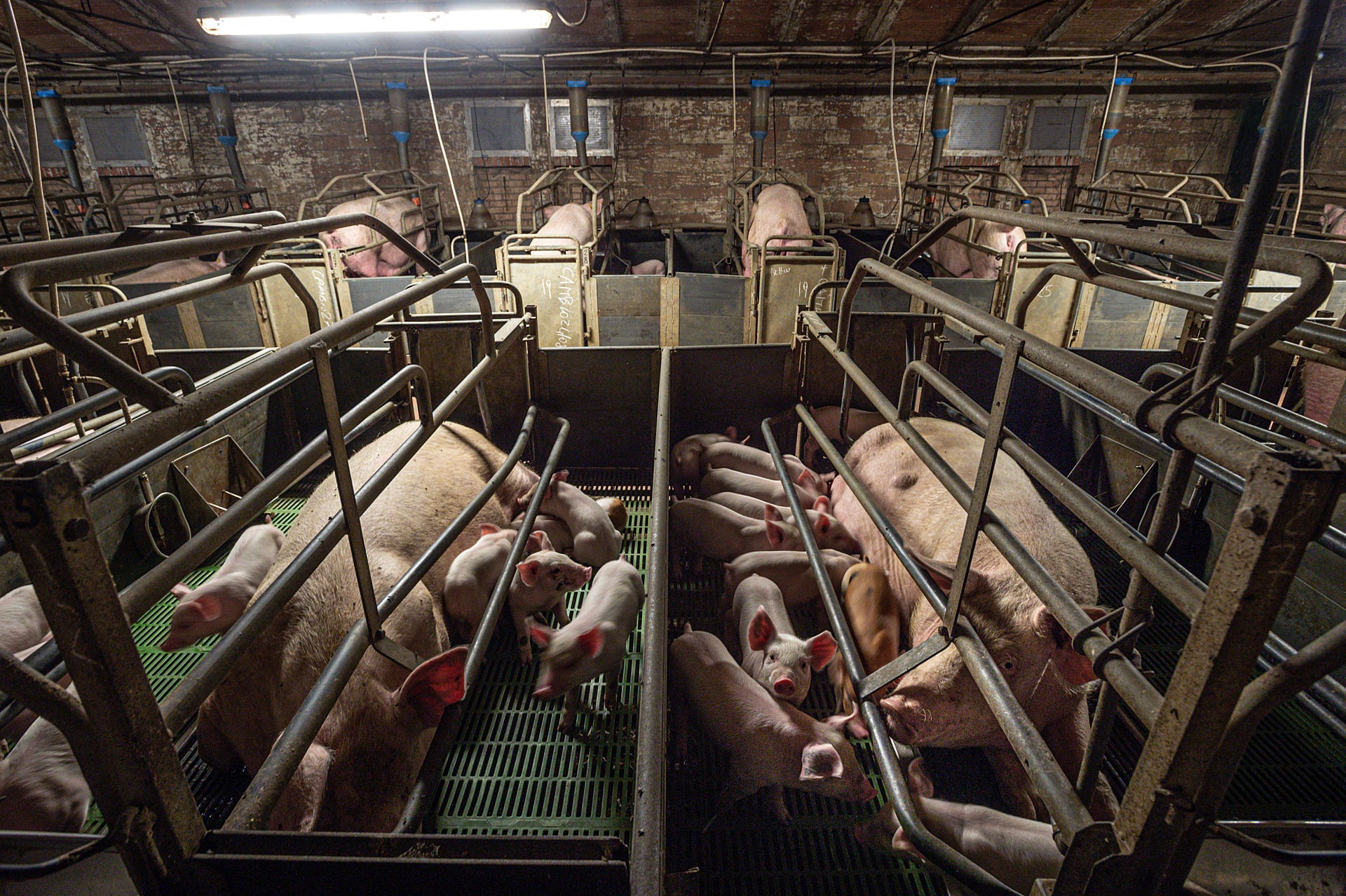
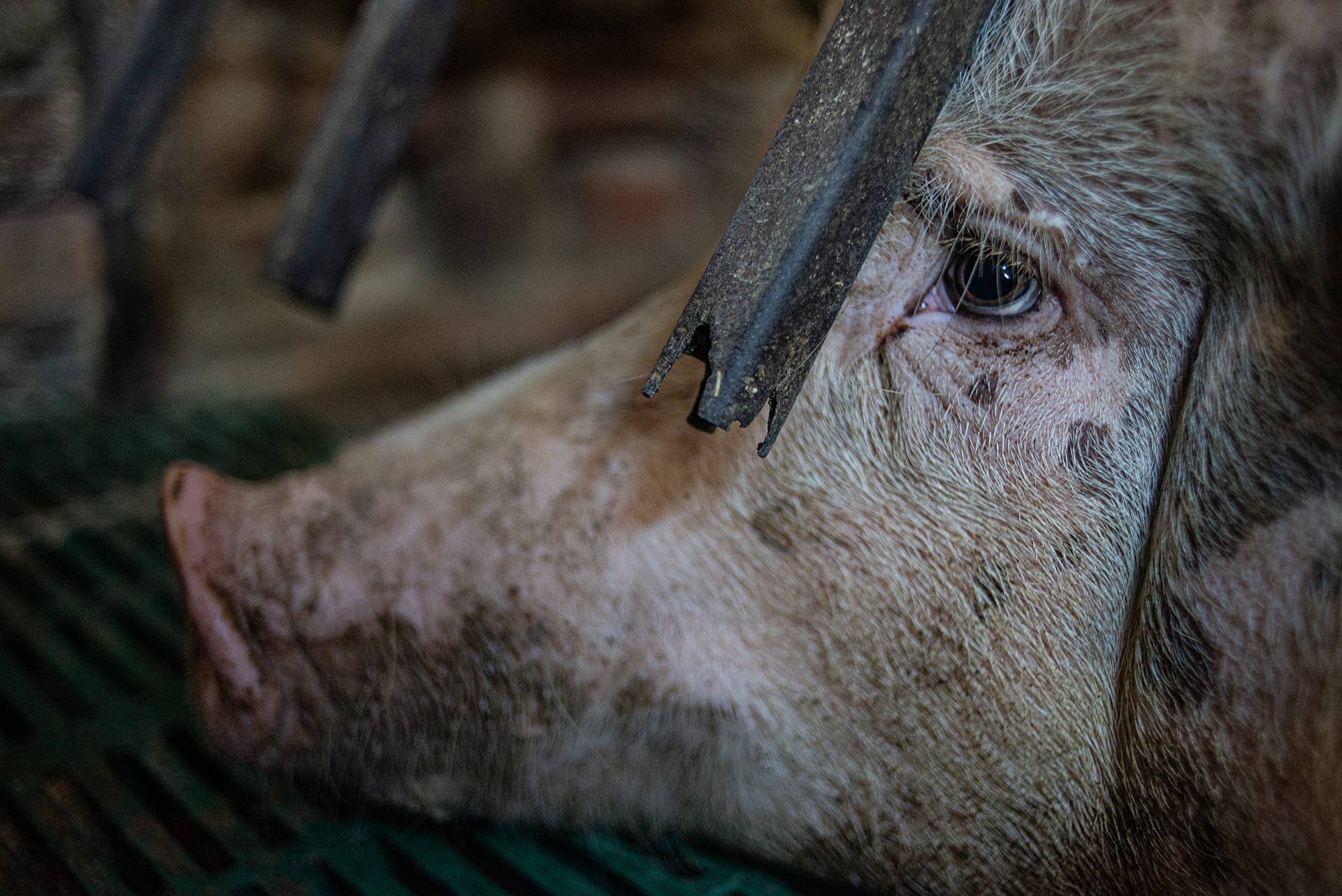
Around 60% of sows in England (200,000 individuals a year) give birth and nurse their piglets confined in a metal-barred farrowing crate barely larger than their own body, unable to turn around. These mothers are prevented from travelling and building a nest: a behavioural need driven by hormones. Instead, they are restricted to a slatted floor, often developing sores on their body. Typically, they spend 5 weeks confined: around a quarter of their adult lives.
In December 2025, the government signalled that this could change, with a public consultation promised for 2026. This article explains the current legal status of farrowing crates in the UK, and how this might change.
Why does the crate exist?
The farrowing crate was invented in the 1960s to prevent piglets getting crushed accidentally by their mother when she rolled over; a problem exacerbated by agricultural practices of selectively breeding pigs to have larger litter sizes, thereby increasing crowding.
Although mortality rates are often used as a justification, this is hard to reconcile with science and pig welfare guidance. Studies show that mortality rates are more affected by other causes related to litter size and farm practices, such as piglets not being able to access enough colostrum due to overcrowding and stress levels of the sow. Whilst the risk of crushing may be lower in some instances with crates, deaths from other causes are higher, so the perceived benefit is mitigated.
Further, even if a justification were accepted that cites slightly lower piglet mortality with crate use, the issues presented by farrowing crates open a wider debate on measuring animal welfare via mortality rather than wellbeing, and the prioritisation of piglets lives over sows. Public opinion alludes to a general view that farrowing crates are not acceptable to use, showing that slightly lowered mortality rates should not be prioritised above overall pig welfare.
What do the public think?
When the British Veterinary Association surveyed its members, 73% had worries about farrowing crates, and more than a third said they were “very concerned”.
When the wider British public was asked, 69% said sows shouldn’t be confined for longer than a few hours, and only when necessary (for example for veterinary treatment). As with many practices in the agrifood industry, most respondents had no idea this was happening at all: 53% had never heard of a farrowing crate before taking the survey, and another 19% said they’d heard the term but didn’t really know what it meant.
Globally, farrowing crates are also an area of contention. Sweden (in 1987), Switzerland (in 1997), and Norway (in 2000) have banned farrowing crates. In more recent years, Finland, Denmark, France, and Germany have all banned building new crates, with phase-out plans to transition farms to free-farrowing. It would be logical for the UK Government to follow suit based on the country’s history with animal welfare law, as the first country to enact national legislation specifically to protect animals in 1822.
Growing public awareness on the issue of farrowing crates could encourage Parliament to follow through with their promise to consult on the matter this year. An ongoing campaign by Animal Rising is raising awareness with the case study of Luna, a three year old sow confined in a farrowing crate, and Michelle Farnham who is currently spending three weeks enclosed in a farrowing crate in central London.
(We are not affiliated with Animal Rising but would like to use this opportunity to raise further awareness to educate our audience about the use of farrowing crates.)

What the law currently permits
The Animal Welfare Act 2006 creates the general offence of causing unnecessary suffering and imposes a positive duty on keepers to take reasonable steps to meet an animal’s welfare needs, including their “need to be able to exhibit normal behaviour patterns”. Farrowing crates that make turning around and nest-building impossible appear incompatible with that duty, however they do not amount to a breach of the AWA because of the Welfare of Farmed Animals (England) Regulations 2007 (WOFAR).
WOFAR Schedule 1, paragraph 9 provides that an animal’s freedom of movement must not be restricted in a way that causes unnecessary suffering or injury — but Schedule 8, Part 4 then sets out the specific conditions for pigs. Paragraph 23 simply requires that sows be “thoroughly cleaned before being placed in farrowing crates”. WOFAR also states there is a requirement for nesting material “unless it is not technically feasible for the slurry system used,” an unobstructed area behind the sow for farrowing, and farrowing rails only where sows are “kept loose.” WOFAR doesn’t specify a minimum pen size or a maximum confinement period, and it assumes the use of a farrowing crate as the default practice.
The Code of Practice for the Welfare of Pigs (England), in force since March 2020, goes slightly further: it recommends that a sow “should only be confined in a farrowing crate for the minimum time necessary.” However, this not a law itself; it is a regulatory code of practice that can hold weight when used as supporting evidence of a breach of the AWA.
In New Zealand in 2020, the legal regulations allowing the use of farrowing crates were challenged by way of judicial review, and the High Court found that farrowing crates were unlawful as they were incompatible with their animal welfare law. Thus far in the UK, there has been no court case to clarify the interaction between the duties to provide for normal behaviour and to not cause unnecessary suffering, and the use of farrowing crates, so it is unclear how a court would rule to reconcile these.
Could farms be prosecuted for using a crate?
Although it is a crime to cause an animal ‘unnecessary suffering’, a farmer is permitted by the law to use a WOFAR-compliant crate and so crate use alone cannot be grounds to prosecute. Additionally, failure to comply with the Code of Practice, as it is not itself a law, is not a crime, only supporting evidence.
Courts have generally taken the view that if Parliament has allowed a farming practice, and the suffering it causes is an 'unavoidable’ part of that lawful practice, it doesn’t count as unnecessary — even if alternatives exist and are used elsewhere.
Despite this, a prosecution could be realistic where an individual animal’s treatment falls short of what the law requires, for example a sow left with visible sores from a crate that doesn’t meet the basic construction standard, no nesting material provided when it was feasible to provide it, or insufficient space for the birth itself. This is where the Code of Practice can be used to evidence further non-compliance with welfare standards, such as keeping the sow confined longer than necessary.
Using a crate currently isn’t a crime but neglecting the few legal safeguards that come with it can be.
(Lawyers for Animals cannot comment on any potential or ongoing prosecutions, but we as a charity are committed to enforcing animal welfare law.)
What could a consultation change?
On 22 December 2025, the government published its Animal Welfare Strategy for England. It says that ending the use of cages and crates is “a key priority,” and commits to working with the pig industry to explore moving away from conventional farrowing crates.
As things stand in mid-2026: UK law puts no lower limit on crate size or maximum confinement time; the Code of Practice offers a suggestion that is legally unenforceable on its own; and the government’s position currently is a promise to consult, not a promise of reform.
Lawyers for Animals are following developments in the law and will update our readers on the 2026 consultation as it happens.

This piece reflects the law and evidence as of September 2026. The government’s promised consultation hadn’t opened at the time of writing. This piece is meant for educational purposes and does not constitute legal advice.
Lawyers for Animals, a registered charitable incorporated organisation in England & Wales. Principal Office: 147 Station Road, Chingford, E4 6AG. Registered Charity no. 1215659.
I would happily subscribe but as a pensioner, I simply don’t have the funds. Support you in spirit. And by sharing
It happens so often, farmed animals are very much forgotten. And pigs are very sensitive animals. The life of a pig mom on a pig farm is absolutely horrendous.. Thank you to lawyers for animals for bringing the farm pig plight to broader attention,